
Sanctions & PEP Screening Guide:
Protecting Your SME from Trade Risks
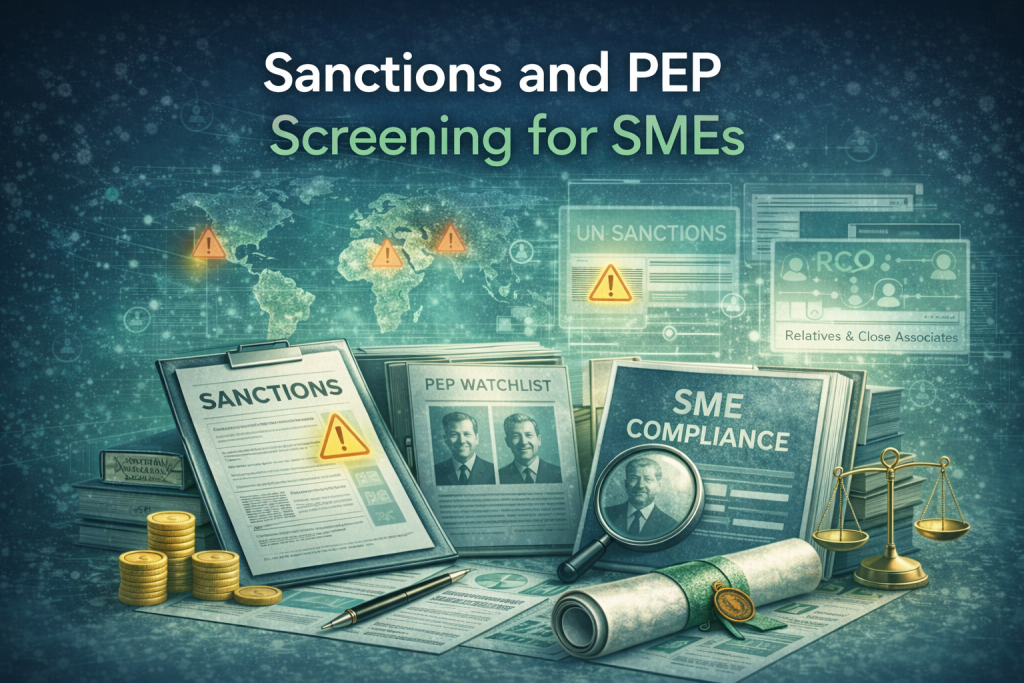
Navigating the Minefield: Why Global Sanctions and PEP Screening are No Longer Optional
In the modern geopolitical landscape, trade is no longer just about supply and demand—it is a front line for international diplomacy. Sanctions have become the primary tool for global powers to exert pressure, and the lists of prohibited entities are growing at an unprecedented rate.
For an international SME, the risks are no longer theoretical. Trading with a partner who was added to an OFAC or EU sanction list just yesterday can lead to the immediate freezing of assets, millions in fines, and the permanent closure of your corporate bank accounts.
In this comprehensive guide, we explore the complexities of international watchlists, the specific risks of Politically Exposed Persons (PEPs), and why screening for “Relatives and Close Associates” (RCAs) is the only way to prevent accidental non-compliance.
The Global Sanction Landscape: UN, EU, and the "Long Arm" of OFAC
A sanction is a trade restriction imposed by a government or international body against a specific country, entity, or individual. To stay compliant, you must cross-reference your partners against multiple lists simultaneously.
United Nations (UN) Sanctions
European Union (EU) Sanctions
OFAC (US Treasury)
The Speed of Change
PEP Screening: Why Political Power Equals Risk
A Politically Exposed Person (PEP) is an individual who holds (or has held) a prominent public position. Because of their influence and access to state funds, PEPs are considered high-risk for involvement in bribery, corruption, and money laundering.
Who is a PEP?
Doing business with a PEP is not illegal, but it triggers the requirement for Enhanced Due Diligence (EDD). You must be able to prove to your bank and regulators that the source of wealth and the source of funds for the transaction are legitimate and not derived from corruption.
Heads of State and Cabinet Ministers.
High-ranking members of the judiciary or military
Senior executives of state-owned enterprises
Influential members of political parties.
The Hidden Circle:Relatives and Close Associates (RCAs)
One of the most frequent ways sanctioned individuals or corrupt officials bypass screening is by using “fronts.” This is why modern compliance requires screening for RCAs (Relatives and Close Associates).
Why RCAs Matter:
If a high-ranking official in a high-risk jurisdiction wants to purchase equipment or move money, they may use their spouse’s or child’s name on the contract.
The Family Link
The Business Associate
Geographic and Geopolitical Risk: Beyond the Person
Sometimes, the risk isn’t the person, but where they operate. Geographic Risk is a major component of a professional KYC report.
Certain regions are flagged for:
- High Corruption Levels: Countries where bribery is an integrated part of the business culture.
- Conflict Zones: Regions where trade may inadvertently fund armed groups.
- Non-Transparent Jurisdictions: “Tax havens” or countries that refuse to share UBO data with international regulators.
When trading with these regions, even a “clean” sanction hit requires extra scrutiny of the Operational Integrity of the business to ensure the trade flow makes sense.
The "Bank Death Penalty": "What Happens if You Miss a Hit?
For a mid-market SME, the biggest threat is not the government fine—it is the loss of your banking relationship. Banks use automated “Screening Engines” to scan every international wire transfer.
The Hit
A transfer is flagged because the recipient’s name (or an RCA link) matches a sanction list.
The Block
The Inquiry
The De-risking
How to Build a Proactive Defense
A professional Sanctions & PEP Audit is your insurance policy. It moves you from “we hope we’re safe” to “we know we’re compliant.”
A professional report from KYC Checks B.V. ensures:
Multi-List Coverage
RCA Detection
Expert Verification
Audit-Ready Proof
Trading Safely in a Shifting World
Geopolitics will only become more complex in the coming years. For the international trader, compliance is no longer a background task—it is a core business strategy. By identifying Sanction and PEP risks at the onboarding stage, you protect your capital, your reputation, and your future.
Don’t let a geopolitical shift destroy your business.
For a fixed fee of €175, KYC Checks B.V. provides real-time, expert-verified Sanctions and PEP screening for your international partners.
Start Your First Verification Now
Fill in the details below to request your KYC report. Our team will review the information and contact you within 2 business hours to confirm the scope and finalize the process.
Before submitting, please choose the level of review that matches your risk profile:
Basic Check (€175)
Standard ownership, sanctions, PEP and adverse media screening.
Advanced Check (€250)
Includes enhanced structure analysis via external intelligence providers, extended PEP and adverse media screening, and import/export plus geographic risk assessment. Recommended for complex or higher-risk international transactions.