
6th AML Directive (6AMLD) Guide:
Protecting Your International SME
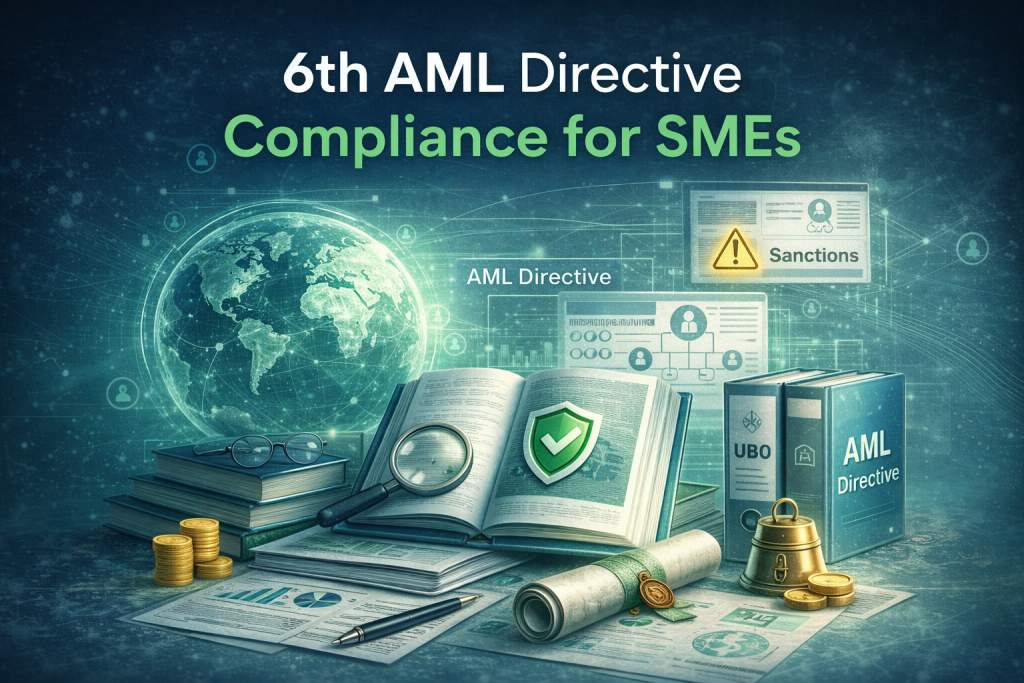
Beyond the Action Movies: Why the 6th AML Directive is a Critical Operational Threat to Your Business
For many business owners, terms like “Money Laundering” and “Terrorism Financing” (CTF) sound like plot points from a Hollywood thriller. However, in the reality of global supply chains, these are not distant concepts—they are immediate operational risks.
With the full implementation of the 6th Anti-Money Laundering Directive (6AMLD) across Europe, the regulatory landscape has shifted. The stakes for Small and Medium-Sized Enterprises (SMEs) have never been higher. Compliance is no longer a “big bank problem”; it is a survival requirement for any company trading across borders.
In this comprehensive guide, we dive deep into the mechanics of financial crime, the expansion of legal liability under the Wwft, and the specific red flags that could trigger a bank audit or a frozen account.
What is 6AMLD? The Expansion of Financial Crime
The 22 Predicate Offenses
The 6AMLD identifies 22 specific crimes that are now officially categorized as money laundering across all EU member states. These include:
Environmental Crime
Cybercrime
Tax Crimes
Corruption and Bribery
The Mechanics of Risk: How Your Trade is Exploited
Shell and Shelf Companies
Layering and Integration
Layering involves moving funds through complex transactions to distance them from the source. In a trade environment, this looks like:
- Phantom Shipping: You are asked to pay for goods that are never delivered, providing a “legitimate” reason for a bank transfer.
- Multiple Invoicing: Issuing several invoices for a single shipment to justify moving large sums of money.
Trade-Based Money Laundering (TBML)
TBML is one of the most complex forms of laundering. It involves misrepresenting the price, quantity, or quality of goods.
- Over-invoicing: A partner sends you goods worth €10k but invoices you for €100k. The extra €90k is “cleaned” through your bank account.
- Under-invoicing: You receive €100k worth of goods but are invoiced for €10k, allowing the partner to retain high-value assets secretly.
Liability Shift: The End of "Wilful Blindness"
The most significant shift brought by 6AMLD and the Dutch Wwft (Wet ter voorkoming van witwassen en financieren van terrorisme) is the clarification of who is responsible.
Expansion to Legal Entities
Previously, criminal liability often focused on individuals. Under 6AMLD, legal entities (your company) can be held liable for the criminal activities of employees or representatives. If a lack of supervision allowed a money laundering transaction to happen, the company itself faces criminal charges.
The “Duty of Care” (Wwft)
Under Dutch law, you have a proactive “Duty of Care.” This means:
- KYC/KYB: You must identify and verify the identity of your customer or supplier.
- UBO Verification: You must know exactly who the “Ultimate Beneficial Owner” is—the person who owns more than 25% or has significant control.
- Ongoing Monitoring: You must ensure that the transactions of your partner remain consistent with their known risk profile.
The “I Didn’t Know” Fallacy: Under 6AMLD, “wilful blindness” (deliberately ignoring suspicious signs) is a criminal offense. If a regulator determines you ought to have known a partner was high-risk, you face massive fines, up to 4 years of imprisonment for directors, and the loss of your banking services.
Top 10 Red Flags for International Traders
Early detection is your only defense. If you spot any of these signs, you must stop the onboarding process immediately and perform Enhanced Due Diligence (EDD).
1. Opaque Ownership
2. Sudden Volume Spikes
3. Circular Trade
4. Third-Party Payments
You are asked to pay an entity that is not listed on the contract.
5. Address Discrepancies
The registered business address is a virtual office or a residential apartment in a high-risk region.
6. Adverse Media Hits
7. Inconsistent Logic
8. Pressure for Speed
9. Geographic Mismatch
10. Sanction Proximity
Building Your "Defense Dossier"
When a bank blocks your transaction, they usually give you 48 hours to provide proof of due diligence. If you are unprepared, your business stops.
A professional KYC Report acts as your “Defense Dossier.” It proves to the bank, the DNB, and your auditors that you have:
- Verified the UBO and checked for PEP (Politically Exposed Persons) status.
- Cross-referenced the entity against global sanction lists.
- Audited the physical operational reality of the business.
- Screened for adverse media in local languages.
Compliance as a Competitive Advantage
The 6th AML Directive has made the world smaller and the risks higher. But for SMEs that take compliance seriously, it is also a competitive advantage. Being “bank-ready” means your transactions move faster, your reputation remains spotless, and your business is protected from the predatory tactics of criminal networks.
Don’t wait for the bank to freeze your accounts. Professional due diligence is no longer a luxury—it is the foundation of global trade.
Secure your next deal today.
For a fixed fee of €175, KYC Checks B.V. provides the enterprise-level intelligence you need to stay compliant and keep your capital flowing.
Start Your First Verification Now
Fill in the details below to request your KYC report. Our team will review the information and contact you within 2 business hours to confirm the scope and finalize the process.
Before submitting, please choose the level of review that matches your risk profile:
Basic Check (€175)
Standard ownership, sanctions, PEP and adverse media screening.
Advanced Check (€250)
Includes enhanced structure analysis via external intelligence providers, extended PEP and adverse media screening, and import/export plus geographic risk assessment. Recommended for complex or higher-risk international transactions.