
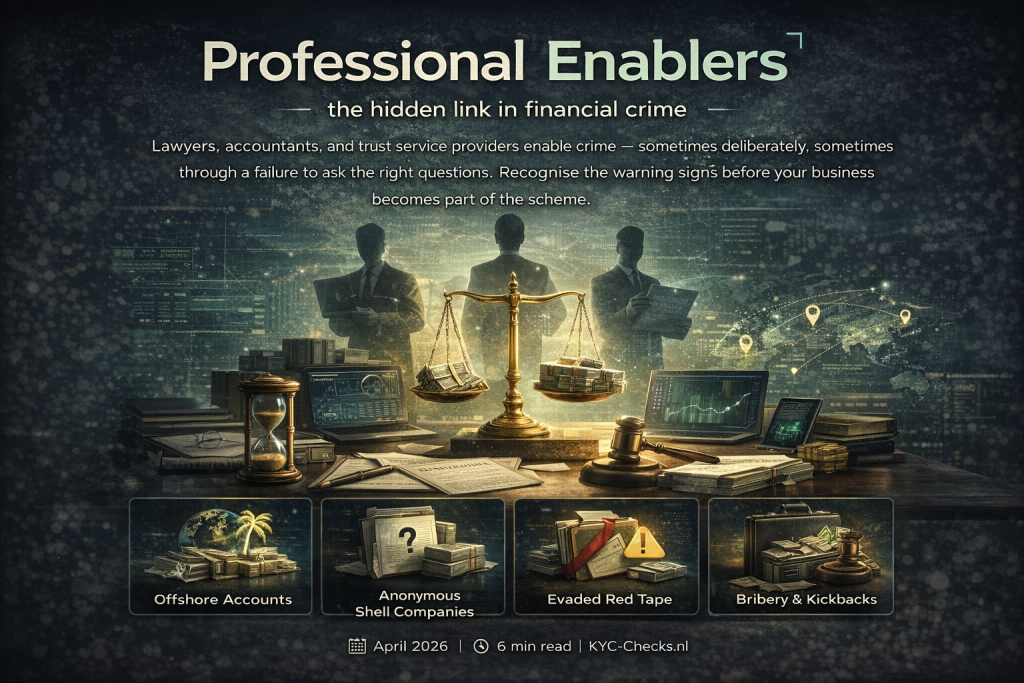
Professional enablers:
the hidden link in financial crime

Lawyers, accountants and trust service providers enable crime — sometimes deliberately, sometimes through a failure to ask the right questions. Recognise the warning signs before your business becomes part of the scheme.

Your adviser recommends a structure that everyone uses. The notary asks no questions. The shares are transferred via a client account. On paper, everything looks fine. But behind that reassurance lies one of the most underestimated risks in KYC: the professional enabler — the adviser who, knowingly or not, facilitates financial crime.

What are professional enablers?

The term professional enabler refers to professionals who facilitate financial crime through their knowledge, title or reputation. This does not always need to be intentional: negligence, a failure to ask critical questions or the blind execution of instructions all fall within this definition.

Both the OECD and the FATF have identified professional enablers as one of the principal risk factors in modern money laundering and fraud investigations. Their findings are consistent: professionals provide the structures, the legitimacy and the access that criminals need to launder assets or circumvent sanctions.


How does it work in pratice?

This pattern — using professionals as intermediaries — recurs in investigations worldwide, including the Panama Papers, Paradise Papers and Luanda Leaks. The mechanism is always the same:

📋 A typical scenario

1

A criminal wants to invest illicit proceeds in real estate.

2

The money is transferred via a lawyer’s client account — no questions asked about the source of funds.

3

A trust service provider incorporates a company with a nominee director, keeping the beneficial owner out of sight.

4

An accountant prepares the annual accounts and lends credibility to the financial picture.

5

The real estate transaction is completed by a notary — on paper, everything looks in order.

6

The criminal proceeds have been converted into a legitimate asset. The beneficial owner is invisible throughout.

Why does this pose a risk to your business?

Many business owners place blind trust in their advisers. But if a professional you engage is themselves part of an enabler scheme, your company can inadvertently become part of an illegal structure — without you being aware of it.

What are the consequences for your business? Reputational damage through association with criminal activity, criminal liability if you should have recognised red flags, frozen bank accounts, loss of your banking relationship, and in serious cases sanctions exposure if the professional facilitated a sanctioned party.

The legal standard in the Netherlands, the UK and the US is clear: the question is not only what you knew, but what you ought to have known. If you engaged a professional who displayed clear red flags and you ignored them, you may share liability.

International enforcement — professionals in the crosshairs

Regulators and law enforcement agencies worldwide are increasingly targeting the professional facilitators behind financial crime:


 Case / AuthorityWhat happened?Date
NLTrust firm / DNBTrust firm dismantled for managing nominee directors and offshore holdings for criminal networks. DNB revoked the licence and imposed a multi-million euro fine.2024
GBAccountant network / NCANetwork of accountants dismantled for setting up hundreds of shell companies with nominee structures for sanctioned Russian entities. Criminal proceedings commenced.2024
FITax advisers / FIN-FSATax advisers and corporate service providers implicated in schemes to conceal income through foreign holding structures. Professional disbarment imposed.2023
🌐OECD — enablers reportOECD published a comprehensive report on the role of lawyers, accountants and trust service providers in cross-border financial crime, with recommendations for tightened regulation.2023
The message from regulators is unambiguous: professionals who ignore red flags are increasingly in the crosshairs themselves — not just the criminals behind the scheme. The defence of “I was only following instructions” carries less and less weight with judges and regulators.

Recognise the red flags

Use this list when assessing professionals you engage or with whom your business partners work. A single hit justifies further investigation:

🚩 Warning signs that a professional poses a risk

Executes instructions without asking critical questions — a professional who never probes the source of funds or the commercial rationale of a structure is a risk.

Avoids direct contact with the UBO — if the adviser actively avoids contact with the beneficial owner, this is a classic indicator of a nominee arrangement.

Proposes ready-made structures without a commercial rationale — a company, foundation or offshore structure that can be “delivered today” and whose purpose remains unclear.

Communicates exclusively through intermediaries — this obscures who is actually making decisions and makes accountability practically impossible.

Creates time pressure — urgency is a standard technique to prevent critical questions from being asked.

Minimises compliance risks — phrases such as “everyone does this” or “this is fully legal” are warning signals, not reassurance.

Refuses to share due diligence documentation — a legitimate professional has no objection to transparency about their own practice.

Has negative press coverage or reputational issues — a quick OSINT check on the individual and firm is always worthwhile.

Recommends structures in secrecy jurisdictions without explanation — offshore holdings in the Cayman Islands, BVI or Panama without a demonstrable commercial purpose are a red flag.

Is registered as director of dozens or hundreds of other entities — this is a classic indicator of a nominee arrangement without genuine involvement.

What can you do?

Professional enablers are a manageable risk — if you know what to look for. Practical steps:

  • Screen the background of advisers you engage: search by name, firm and any disciplinary decisions.
  • Always probe illogical structures: what is the commercial rationale for this layer? Why this jurisdiction? Who is the beneficial owner?
  • Conduct independent screening on business partners introduced through external advisers — their adviser may have an interest that conflicts with yours.
  • Document your decision trail: record the questions you asked, the answers you received and how you reached your conclusion. This is your defence in any subsequent investigation.
  • Terminate the relationship where red flags arise — and consider whether a Suspicious Activity Report (SAR) is required if you are subject to anti-money laundering obligations.

Download The Professional Enablers Checklist!

Unsure About a Client, Supplier or International Party?

KYC-Checks.nl conducts professional UBO investigations and sanctions screening. Fast, reliable, and bank-grade.

Start Your First Verification Now

Fill in the details below to request your KYC report. Our team will review the information and contact you within 2 business hours to confirm the scope and finalize the process.

Before submitting, please choose the level of review that matches your risk profile:

Basic Check (€175)
Standard ownership, sanctions, PEP and adverse media screening.

Advanced Check (€250)
Includes enhanced structure analysis via external intelligence providers, extended PEP and adverse media screening, and import/export plus geographic risk assessment. Recommended for complex or higher-risk international transactions.

Your info

Your company details

Target company info