
UBO Transparency Guide:
Identifying the Real People Behind the Paperwork
Learn how to navigate global sanction lists (OFAC, EU, UN) and PEP screening. Discover the risks of RCAs and why real-time compliance is critical for SMEs.
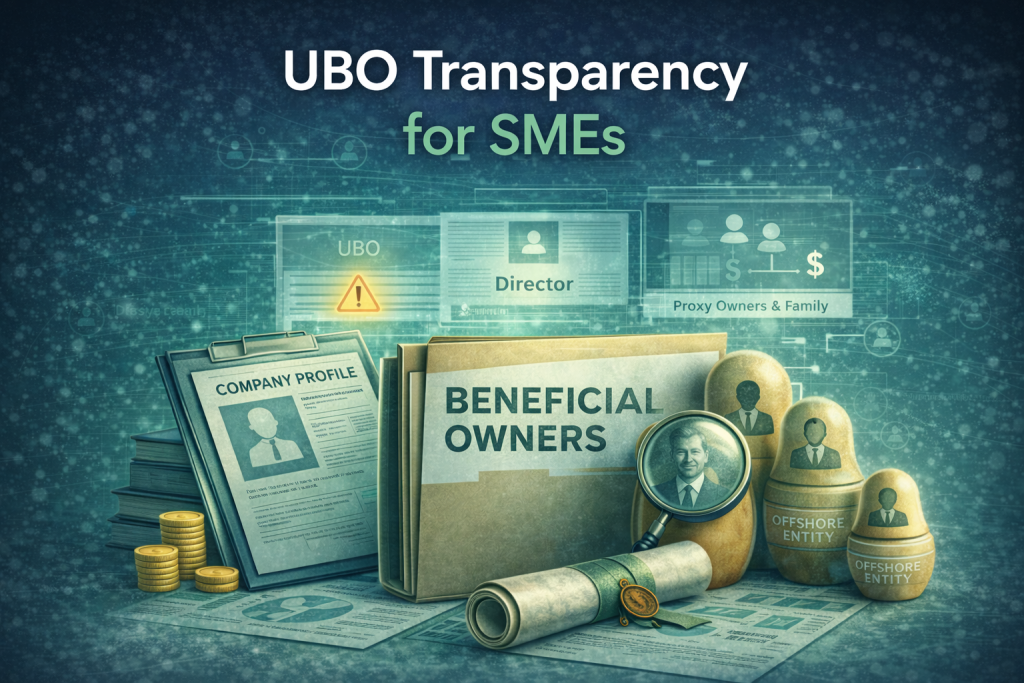
The Power of Ownership: Why Identifying the Person Behind the Paperwork is Critical for Your Business
In the world of international trade, a company’s name is often just a facade. Behind the sleek logos and official-looking registration papers often lies a complex, intentionally opaque web of offshore holdings, trust funds, and proxy owners.
Identifying the Ultimate Beneficial Owner (UBO) is no longer just a “nice-to-have” detail for your compliance file—it is the cornerstone of modern due diligence. With banks closing accounts and regulators imposing record-breaking fines, knowing exactly who you are doing business with has become a survival skill for the mid-market.
In this guide, we explore the “Russian Nesting Doll” problem, the risks of proxy ownership, and why the distinction between a Director and a UBO is the most dangerous gap in your current compliance strategy.
What is a UBO? Defining the "Natural Person"
At its core, an Ultimate Beneficial Owner (UBO) is the natural person (a human being, not another company) who ultimately owns or controls a legal entity.
According to most international standards (including the EU’s AML directives), a person is typically considered a UBO if they:
If they own more than 25% of the shares or voting rights.
If they exercise significant control over the company's management or policies.
If they are the beneficiary of the company’s profits or assets.
The SME Reality
The "Russian Nesting Doll" Problem: Opaque Structures
1. Company A (your partner) is owned by Company B (registered in a different country).
2. Company B is owned by a Trust in a tax haven like the British Virgin Islands.
3. The Trust is managed by a nominee, while the real beneficiary remains hidden in the shadows.
Why this is a threat:
These structures are designed to bypass transparency. If your partner in Germany is secretly owned by a sanctioned oligarch through a chain of five offshore companies, your bank will eventually find out. When they do, it is your transaction that gets blocked, and your reputation that is collateral damage.
Sanction Evasion: The Risk of Proxies and Family Members
One of the most common methods for sanctioned individuals to continue trading with European businesses is through Proxy Ownership.
Proxy Owners & Frontmen
The Family Member Trap
The KYC Checks Advantage: Our reports don’t just look at the current registry; we audit the history of ownership changes to identify suspicious transfers made just before or after sanction announcements.
Why the Bank is Watching Your UBO Data
If you feel that your bank is becoming more intrusive, you aren’t alone. Financial institutions are under immense pressure to prevent “Financial Contagion.”
When you process an international wire transfer, the bank’s AI scans the entire ownership chain of the recipient. If there is a “gap” in transparency or a link to a high-risk jurisdiction, the system triggers a Stop Payment.
The 48-Hour Compliance Window
In most cases, the bank will give you a very short window to provide “Full Ownership Transparency.” If you cannot provide a professional report that maps the UBO back to a natural person, the bank will:
1. Block the transaction.
2. File a Suspicious Activity Report (SAR).
3. Potentially start the process of closing your business account (de-risking).
Total Transparency as a Trading Standard
In the current geopolitical climate, transparency is the new global currency. Companies that can prove they know exactly who they are dealing with move faster, pay less for financing, and enjoy stable banking relationships.
Identifying the UBO is no longer a bureaucratic hurdle—it is a strategic necessity. It protects your brand from being used as a shield for illicit activities and ensures your capital flows remain uninterrupted.
Don’t let hidden owners become your liability.
For a fixed fee of €175, KYC Checks B.V. unmasks the real people behind your international partners. We provide the clarity you need to trade with absolute confidence.
Start Your First Verification Now
Fill in the details below to request your KYC report. Our team will review the information and contact you within 2 business hours to confirm the scope and finalize the process.
Before submitting, please choose the level of review that matches your risk profile:
Basic Check (€175)
Standard ownership, sanctions, PEP and adverse media screening.
Advanced Check (€250)
Includes enhanced structure analysis via external intelligence providers, extended PEP and adverse media screening, and import/export plus geographic risk assessment. Recommended for complex or higher-risk international transactions.