
Operational Integrity & Geographic Risk Guide:
Verifying Business Logic
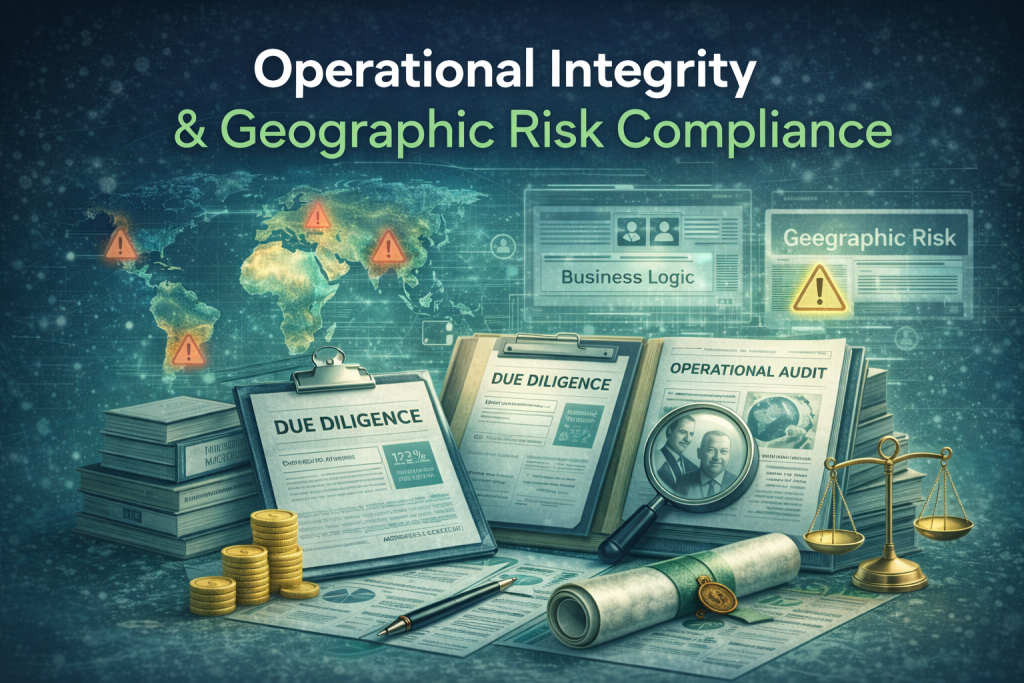
Beyond the Paperwork: Why Operational Integrity and Geographic Risk are the Ultimate Red Flags
In the world of international compliance, it is a common mistake to think that “clean” screening results equal a “safe” partner. You can verify that a company is registered, that the UBO is not on a sanction list, and that there is no adverse media. But there is one question that remains unanswered: Does this business actually make sense?
Regulators and banks are increasingly looking beyond the names on the paper. They are looking for Economic Substance and Business Logic. If you are trading with a partner whose operational reality doesn’t match their corporate profile, you are walking into a compliance trap.
In this final guide of our Risk Academy series, we explore the complexities of Operational Integrity, the hidden dangers of Geographic Risk, and why “Business Activity Logic” is the final frontier in protecting your company from financial crime.
What is Operational Integrity? Verifying the "Physical Reality"
Operational Integrity is the audit of whether a company actually exists and functions in the way it claims to. In an era of “ghost companies” and “letterbox firms,” physical verification is the only way to ensure you aren’t being used as a conduit for money laundering.
Many high-risk entities are registered at “virtual offices” or residential apartments. While not always illegal, a multi-million euro trading company operating out of a small apartment in a tax haven is a massive red flag.
Address Audit
Employee vs. Revenue Logic
Geographic Risk The "Where" Matters as Much as the "Who"
Sometimes, the risk isn’t the person you are dealing with, but the jurisdiction they operate in. Geographic risk is a major component of any Wwft-compliant risk assessment.
Financial institutions categorize countries based on their regulatory transparency. Trading with partners in these regions triggers immediate Enhanced Due Diligence (EDD):
Tax Havens & Non-Cooperative Jurisdictions
Conflict-Adjacent Regions
High-Corruption Zones
Countries where bribery is an institutionalized part of doing business.
The Strategic Risk
Business Activity Logic: Does the Trade Make Sense?
This is the most nuanced part of compliance. Regulators call it Economic Substance. It requires looking at the transaction and asking: “Why is this happening?”
If the “logic” of the trade is missing, the bank’s AI will flag it as a suspicious transaction. Without a professional audit explaining the commercial rationale, your funds will be frozen.
Industry Mismatch
Geographic Illogic
Pricing Anomalies
Fiscal and Tax Risks: The New Compliance Frontier
Under the 6th AML Directive, tax crimes are now a primary predicate offense for money laundering. This means you are responsible for ensuring your partners aren’t using your trade to facilitate tax evasion.
Red Flags for Fiscal Fraud:
- Complex Offshore Chains: Ownership structures that involve multiple layers in different tax havens for no clear operational reason.
- Carousel Fraud (MTIC): A sophisticated scam where VAT is “stolen” through a series of rapid-fire international trades. If you are part of this chain, even unknowingly, you face massive fines and criminal liability.
When a bank compliance officer reviews your international trade, they are looking for a reason to say “Yes.” However, if they see a transaction with no physical substance or logical business purpose, their internal policy forces them to say “No.”
The “De-risking” Trigger
Banks are “de-risking” at an alarming rate. They prefer to lose a customer rather than risk a multi-million dollar fine for a “suspicious” transaction.
- The Solution: A KYC report from KYC Checks B.V. doesn’t just check names. We audit the Business Activity Logic. We provide the bank with the “commercial story” they need to approve your transaction.
Building a "Logic-Proof" Defense File
A professional Operational & Geographic Audit is the final piece of your “Defense File.” It proves to the bank, the DNB, and your auditors that you haven’t just performed a superficial check—you have truly understood the nature of your business relationship.
Our Comprehensive Reports provide:
Physical Address Verification
Geographic Risk Scoring
Business Logic Assessment
Fiscal Red-Flagging
Compliance is an Investigative Art
At its highest level, compliance is not about software or databases—it is about investigation. It is about connecting the dots between a physical location, a business activity, and a geographic risk.
By auditing the Operational Integrity of your partners, you move beyond “checking boxes” and start building a truly resilient, bank-ready international business. Don’t let a “clean” name hide a “dirty” reality.
Trade with absolute certainty.
For a fixed fee of €175, KYC Checks B.V. performs a deep-dive operational audit on your international partners. We verify the logic, so you can focus on the trade.
Start Your First Verification Now
Fill in the details below to request your KYC report. Our team will review the information and contact you within 2 business hours to confirm the scope and finalize the process.
Before submitting, please choose the level of review that matches your risk profile:
Basic Check (€175)
Standard ownership, sanctions, PEP and adverse media screening.
Advanced Check (€250)
Includes enhanced structure analysis via external intelligence providers, extended PEP and adverse media screening, and import/export plus geographic risk assessment. Recommended for complex or higher-risk international transactions.